Chords in Today's Songs
Part 2 - Sept-Oct '26
Discover the chords behind familiar songs and see how they work together. Each week, we'll feature a song and explore a short chord sequence that helps give it its distinctive sound.
Use the Fingertips chord boxes to try the progression yourself — and listen for it when you hear the song.
Strange — Celeste
Featured progression:
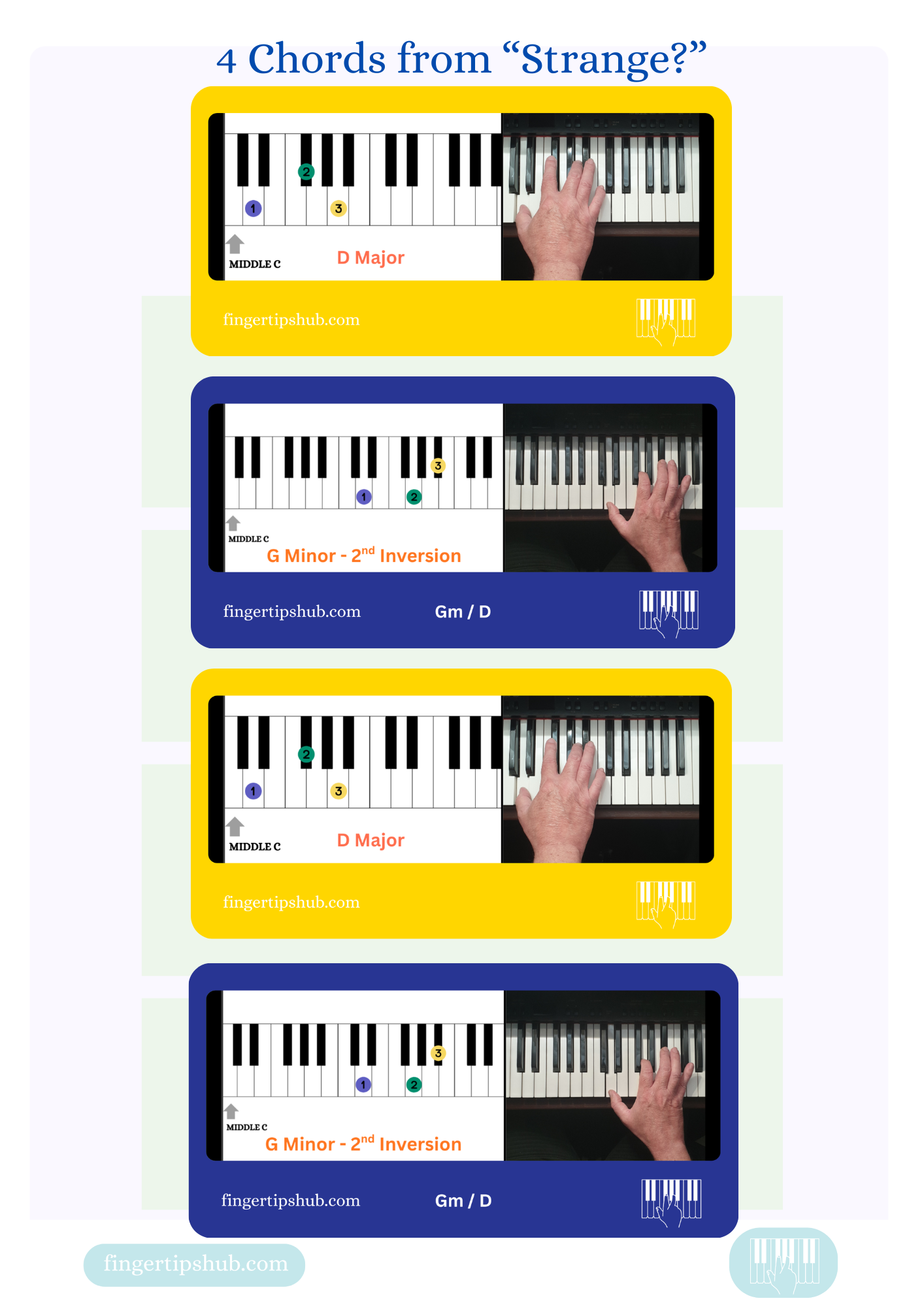
D – Gm/D – D – Gm/D
The opening of Strange has a beautifully distinctive sound, created by alternating between D major and G minor over D.
Keeping D in the bass while the chord above changes from major to minor gives the progression its haunting quality. The D major and Gm/D chords alternate through the opening before the harmony moves on to Bm – Em – G – A, completing the first two lines of the lyrics.
It’s a lovely example of how a very small change in the notes above a steady bass can completely alter the mood of a chord.
D – Gm/D – D – Gm/D – Bm – Em – G – A
The inversion is especially worth noticing here. Rather than hearing G minor simply as a separate chord, keeping D underneath connects it closely to the D major and helps create the characteristic sound of the opening.
My Girl — The Temptations
Featured progression:
C – Dm – F – G
The chorus of My Girl begins with the familiar “I guess you’d say”, and moves through four straightforward chords that show how much can be achieved with simple harmony.
Starting on C major, the progression moves to D minor, then F major and G major. All four chords belong naturally together in the key of C, giving the chorus its bright, easy-flowing sound.
C – Dm – F – G
The G major creates a natural pull back towards C, helping the progression lead smoothly into the next part of the chorus.
It’s a great example of a classic song built from basic major and minor chords — and proof that memorable harmony doesn’t need to be complicated.

Blank Space — Taylor Swift
Featured progression:
F – Dm – B♭ – C
The opening of Blank Space is built around a simple four-chord progression that continues underneath the first verse.
Beginning with F major, it moves to its relative minor, D minor, before continuing through B♭ major and C major. These four chords all belong naturally to the key of F, creating a progression that feels settled and familiar while leaving plenty of space for the melody and rhythm to give the song its character.
F – Dm – B♭ – C
The C major at the end creates a natural pull back towards F, allowing the same four chords to cycle smoothly as the verse continues.
It’s another good example of how four basic major and minor chords can provide the foundation for a distinctive and instantly recognisable song.

Just the Way You Are — Billy Joel
Featured progression:
D – Bm6 – Gmaj7 – Bm
When the lyrics first enter in Just the Way You Are, the harmony begins with D major before moving through Bm6, Gmaj7 and B minor.
Both the Bm6 and Gmaj7 add extra colour to otherwise familiar chords. The added notes help give the progression the smooth, sophisticated sound that is such a feature of the song.
D – Bm6 – Gmaj7 – Bm
There are also strong connections between these chords. D major and B minor share two notes, while Gmaj7 contains the complete B minor triad — B, D and F♯ — with G underneath. That helps the changes flow particularly smoothly.
It’s a lovely example of how extended and colour chords can make a progression sound richer while still being built around very familiar major and minor harmony.

When the Party’s Over — Billie Eilish
Featured progression:
F♯m – C♯m – E – A
The chorus of When the Party’s Over uses these four chords as “I could lie, say I like it like that” comes in.
The song is in E major, but this progression begins on F♯ minor and moves to C♯ minor before reaching E major and A major. Starting away from the home chord helps give the chorus its subdued, unresolved quality.
F♯m – C♯m – E – A
All four chords belong naturally to E major: F♯m and C♯m are the ii and vi minor chords, while E and A are the I and IV major chords.
It’s a great example of how the same family of chords can create a very different mood simply through their order — here placing the two minor chords first gives the progression much of its emotional character.
