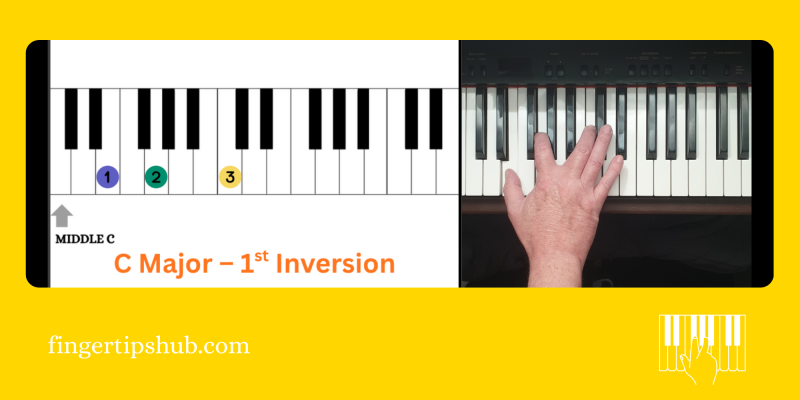
Every chord has more than one way to fall under your fingers —
and each shape tells its own story.
Inversions – Finding the Shape That Fits
(48 Essential Chords book: p.68)
When you first learn a chord, it is usually shown in a single position. In practice, however, chords can be rearranged by placing their notes in different orders. These variations are called inversions.
In real playing, inversions are not about theory — they are about movement, comfort, and sound. Different shapes allow your hand to move more smoothly from one chord to the next, reducing jumps and keeping the music flowing.
Inversions are also often chosen to shape the bass line itself. By placing the root, third, or fifth in the lowest position, the bass can move stepwise or melodically rather than jumping from note to note. This is not a theory device — it is a musical one, used to support the tune and give the harmony a sense of direction.
Each inversion has its own character. Some feel bright and open, others fuller or more settled. Choosing the shape that fits naturally under your fingers helps your playing feel musical rather than mechanical.
A Selection of inversion examples
(The full Fingertips website covers inversions much more extensively)